Trade Corridors is an Economic Engine for Rebuilding
14.05.2026

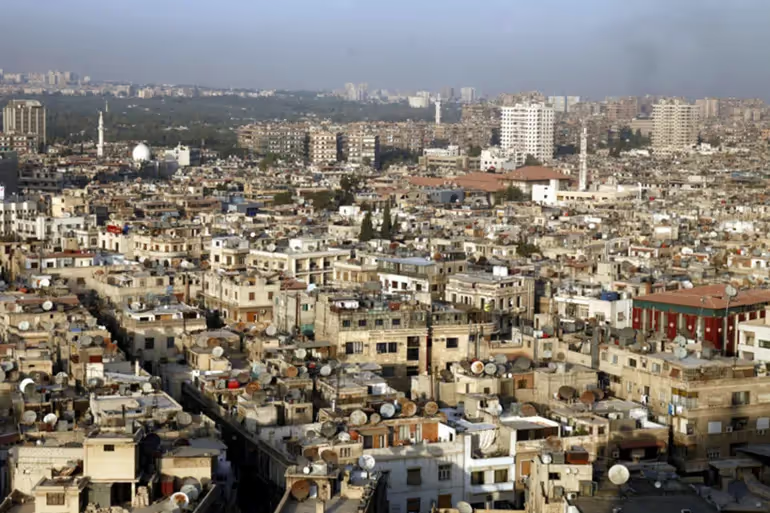
Damascus is advancing the concept of a secure Syrian corridor as a rapid economic entry point for reconnecting the country to regional trade, energy, and transport networks. The proposal gains urgency against a backdrop of constrained public finances, reduced industrial capacity, and an oil sector still far below pre-conflict output levels. Disruption to maritime shipping lanes, particularly in the Red Sea, has simultaneously elevated the strategic value of overland routes for countries seeking alternatives less exposed to logistical interruption.
The Trilateral Framework
The Syrian corridor concept moved from idea to formal agreement when Syria, Jordan, and Turkey signed a trilateral memorandum of understanding in Amman, committing to develop the transport sector and strengthen trade and transport links among the three countries. The memorandum establishes a joint institutional and technical framework covering land, maritime, and rail transport, and creates specialized committees and working groups to harmonize procedures and policies. A three-year roadmap accompanies the agreement, aiming to transform border crossings from simple transit points into hubs for economic integration and joint development.
The railway sector is a central priority. Turkey has pledged to finance maintenance of the Hejaz Railway segment from Damascus to the Jordanian border, while Jordan will assess its technical capacity for locomotive maintenance and operation. The three countries have also agreed to conduct joint feasibility studies to improve Turkey's access to the Red Sea through Jordan's Port of Aqaba. Turkey additionally committed to completing approximately 30 kilometers of missing track infrastructure on the Syrian segment of the line.
Saudi Arabia and the Broader Regional Dimension
Saudi Arabia has expanded the regional scope of the project, with Transport Minister Saleh Al-Jasser announcing that studies for a rail line linking the Kingdom to Turkey via Jordan and Syria are to be completed within the year. This sequence of commitments gives Damascus an economic asset that can be leveraged quickly, placing Syrian territory within a transport map that the region urgently needs as it searches for overland routes less vulnerable to disruption. The corridor also opens potential revenue streams from transit fees, storage, logistics services, maintenance, and operations, providing the Syrian economy with an early cash flow before any full recovery of its productive base.
European Engagement and Its Negotiating Value
The European Union approaches this track from a broader angle encompassing trade, energy, digital connectivity, and security and border management. Reuters previously reported on a European document calling for the repair of relations with Damascus, the strengthening of commercial and security cooperation, and the integration of Syria into regional connectivity projects, including the India-Middle East-Europe Economic Corridor (IMEC). The European Commission has since proposed resuming the 1978 EU-Syria Cooperation Agreement ahead of scheduled talks with the Syrian side.
Syrian President Ahmad Al-Sharaa has presented this vision directly to European and regional partners, stating that Syria is positioned to become a secure strategic corridor linking Central Asia and the Gulf with Europe, and placing before partners the Four Seas Initiative and the Nine Corridors Initiative as the framework for this ambition.
The Corridor as an Internal Economic Tool
Economic analyst Dan Qazzi argues that the value of Syrian territory in regional connectivity projects derives from its capacity to combine transport, storage, customs, and technical services into a single chain that can be priced and monitored. Any transit corridor therefore requires a clear economic architecture that defines transit tariffs, collection mechanisms, local employment ratios, and the share of accompanying services allocated to Syrian companies, since the real return accumulates around the route through maintenance, insurance, packaging, and re-export activities.
Qazzi adds that converting transit traffic into stable income requires rules that prevent the concentration of profits in the hands of large intermediaries and operators of crossings and logistics zones. The most important economic benchmark is the corridor's ability to reduce transport costs for Syrian producers, connect agriculture and light industry to new markets, and channel a portion of fees toward electricity infrastructure, secondary roads, and storage centers. Only then does the corridor become an internal economic instrument rather than a service for passing regional trade.
Syria Within a Crowded Regional Race
Syria does not appear in this landscape as a standalone route capable of displacing existing corridors, but rather as an additional pathway that Damascus is attempting to insert into a map already crowded with competing interests. Large-scale projects, from IMEC to the Iraqi-Turkish Development Road and the port networks stretching from the Gulf to the eastern Mediterranean, are all vying to connect the Gulf with Turkey and Europe. The value of Syria's geographic position remains contingent on the country's ability to generate the conditions of trust, stability, and legal governance over contracts and crossings.
Syrian writer and lawyer Anas Jawda notes that the southern Syrian corridor represents the most sensitive link in any overland connection toward Jordan and the Gulf, as the route requires continuous security management and clear administration of crossings and borders. Local tensions and Israeli security calculations near the border render this part of the Syrian map vulnerable to disruption, giving any external party reason for caution before committing to long-term transit arrangements.
14.05.2026
Syrian corridor, regional connectivity, rail, Hejaz Railway, Turkey, Jordan, Saudi Arabia, European Union, logistics, rebuilding, trade


.svg)

.avif)