Syrian Customs Delegation Studies Mersin Port Model to Develop Free Zones and Trade Corridors
15.08.2026

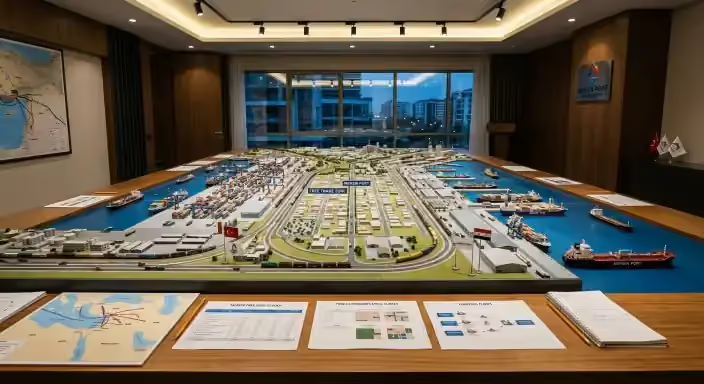
A Field Visit to Turkey's Logistics Hub
A delegation from Syria's General Authority for Border Crossings and Customs conducted a working visit to Mersin, Turkey, including field tours of Mersin port and its free zone alongside meetings with officials and business representatives. The delegation examined port operating mechanisms, container handling procedures, and technologies used to accelerate vessel movements and associated customs processes.
Political and economic researcher Basel Kuwaifi, speaking to Al-Watan, described Mersin as a practical model in port and free zone management, citing its ability to combine industrial activity, commercial operations, logistics services, and maritime freight movement.
Trade Volume and Bilateral Targets
The visit comes as Syrian-Turkish trade is expanding at a notable pace. Kuwaifi stated that trade between the two countries reached approximately 3.75 billion dollars in 2025, representing growth of around 45 percent, with the exchange continuing to grow through the first seven months of 2026. Both sides are targeting an annual trade volume of approximately 10 billion dollars, a goal that requires addressing the trade imbalance and raising Syria's export capacity.
Kuwaifi noted that Turkish exports continue to hold a large share of the Syrian market, particularly in foodstuffs, construction materials, machinery, and chemicals, while Syrian exports remain comparatively limited.
Syrian Ports and Free Zones as Production Centres
Kuwaifi argued that linking the Mersin experience to Syrian ports and free zones, particularly in Latakia and Tartus, alongside commercial and industrial centres in Aleppo and Idlib, would reduce customs clearance times and improve cargo movement efficiency. He stressed that real benefit will not come simply from increased truck and border crossing activity, but from the capacity of Syrian industry, agriculture, and services to reach Turkish and regional markets, and from transforming free zones into production and export hubs rather than mere import entry points.
Regional Connectivity: Transport and Energy
Cooperation extends beyond conventional trade to encompass transport, energy, and regional connectivity. Kuwaifi noted that the activation of the gas pipeline running from Kilis to Aleppo represented a step in supporting Syria's energy needs. Railway connectivity projects and border crossing development also feature in a broader vision to reconnect Turkey with Syria, Jordan, and Gulf markets, potentially allowing Syria to gradually recover its role as a transit corridor between the Mediterranean and the Gulf.
Legislative Reform as an Investment Prerequisite
Kuwaifi stated that developing free zones requires parallel modernisation of the legislative and regulatory environment, particularly customs laws, investment procedures, and free zone management frameworks. He noted that investors require clarity in legislation, speed in procedures, and policy stability, in addition to infrastructure capable of absorbing trade flows, emphasising that geographic position alone is insufficient to position Syria as a regional trade centre.
Source: Al-Watan
15.08.2026
free zones, Mersin port, Syrian customs, Syrian-Turkish trade, logistics, Syria ports, trade exchange


.svg)

.avif)