Presidential Decree 162 appoints Ahmad Rawad Ramadan as Director-General of the Syrian Investment Authority
05.08.2026

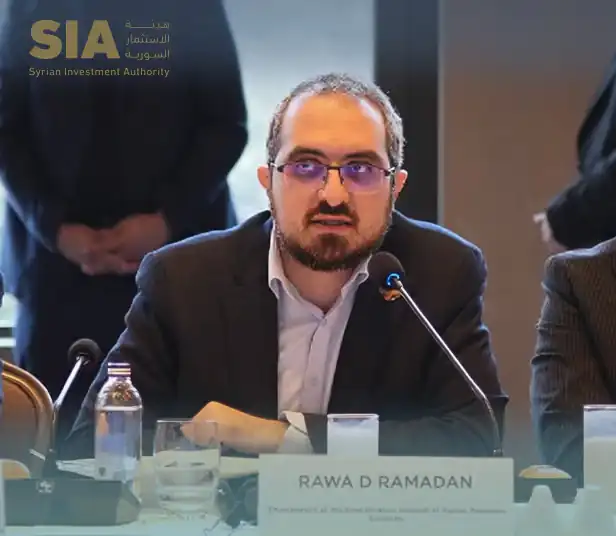
President of the Syrian Arab Republic Ahmad al-Sharaa has issued Decree No. 162 of 2026, appointing Mr Ahmad Rawad Muhammad Bashar Ramadan as Director-General of the Syrian Investment Authority.
What the decree says
The decree was issued under the provisions of the Constitutional Declaration and the provisions of Decree No. 114 of 2025. Its articles read:
- Article 1: Mr Ahmad Rawad Muhammad Bashar Ramadan is appointed Director-General of the Syrian Investment Authority.
- Article 2: Anything contrary to the provisions of this decree is repealed.
- Article 3: This decree shall be communicated to those responsible for its implementation.
Decree No. 114 of 2025, cited as the basis for the appointment, is the decree that amended articles of the Investment Law, as announced by the Syrian Investment Authority on its official website.
The new Director-General
According to the profile published by the Syrian Investment Authority, Rawad Ramadan is a Syrian architect holding a university degree in architectural design, and his experience combines an engineering background with executive work in structuring investments, developing projects and building public-private partnerships.
Founding and running companies
Ramadan took part in founding a number of companies in investment fund management, securities, real estate development and renewable energy, and has managed major companies across several fields.
- He co-founded a company specialised in managing real estate investment funds and venture capital and chaired its board, until it became third in Turkey among the non-bank portfolio management companies specialised in this field.
- He held the executive leadership of an investment group working in real estate development, renewable energy, tourism, retail and infrastructure, and oversaw the development and management of a number of major projects and assets.
His role in the business councils
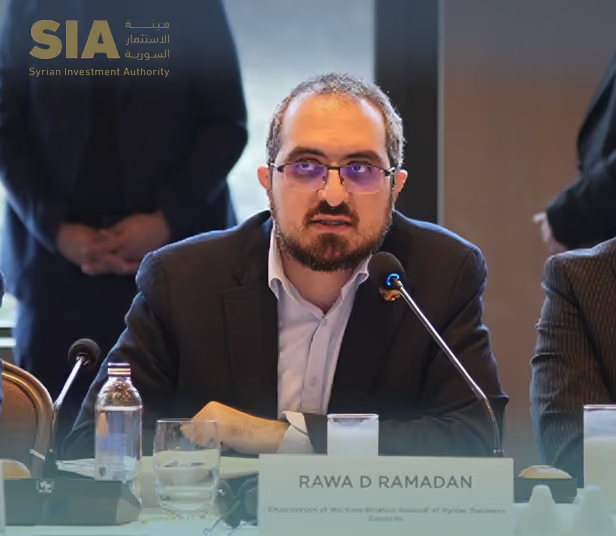
Ramadan chaired the Syrian Council for Coordinating Business Councils, where he organised the system of joint councils and widened its relations with international markets, with the aim of turning the councils into instruments for attracting investment, increasing exports and strengthening the private sector's role in economic activity. He contributed to founding 18 joint Syrian business councils with countries around the world, and took part in founding an internationally accredited research centre.
At the launch of the operational charter for Syria's joint business councils in June 2026 he said that working within a unified national system gives the private sector a more cohesive institutional voice before partner countries, and that the system rests on the principles of participatory governance and institutional discipline.
The charter set four main objectives for the business councils: raising Syrian exports, attracting investment and economic partnerships, securing business opportunities for Syrian companies, and raising the efficiency and international competitiveness of the private sector.
The Syrian Investment Authority and its role
On its official website the Authority describes itself as the national body for investment development in Syria, and as the official body responsible for creating a suitable investment environment, providing facilities to investors and supporting projects across sectors. Its head office is in Damascus, in Sabaa Bahrat.
Ten branches and a single window
The Authority operates through ten branches in the governorates. Each branch delivers the services related to investment projects through a single window, without the investor needing to go to the central administration except for specific transactions such as obtaining a customs exemption for the project's imports.
The published branches cover Aleppo, Latakia, Tartus, Hama, Hasakah, Raqqa, Daraa, Sweida and Quneitra, alongside the central administration in Damascus, which handles general supervision of investment policy and coordination between the branches.
The investment map and published indicators
The Authority publishes an investment map that lets users filter available opportunities by sector and by governorate. Its home page displays indicators of 373 investment opportunities, more than 71 investment licences, more than 10,000 jobs, and investment costs of 2,535 billion.
An example of its activity
Among the projects the Authority has announced on its website is the start of trial production at the Tartus cement plant in April 2026, after initial maintenance work was completed and a comprehensive rehabilitation plan for the production lines began, within a five-year investment plan by QZ Investment. The Authority described it as a model of integrated partnership between the public and private sectors.
Why this matters for the rebuilding sector
The Authority is the formal entry point for any project seeking an investment licence in Syria, including construction, real estate development, infrastructure and industry. Its branch network in the governorates is the channel through which companies follow their procedures without passing through the centre at every step.
The background of the new Director-General, an architect who has worked in real estate development and investment structuring, places the language of the engineering and property sector in the decision seat inside the Authority. For contractors, engineering offices, developers and investors, the leadership of the Authority means the office to which licence applications are submitted and through which incentives and facilitations are followed up.
- Text of Decree No. 162 of 2026, Presidency of the Syrian Arab Republic.
- Profile card of the Director-General issued by the Syrian Investment Authority.
- SANA, launch of the operational charter for Syria's joint business councils, 2 June 2026
- Syrian Investment Authority, official website
- Syrian Investment Authority, branches in the governorates
05.08.2026
Syrian Investment Authority, Rawad Ramadan, Decree 162, architect, investment licence Syria, Syrian business councils, investing in Syria, rebuilding Syria

.svg)

.avif)
.svg)