.avif)
Rehabilitation of the Tartus Port to Talkalkh Rail Line


.svg)


.avif)
.svg)

Rehabilitation Works Launched
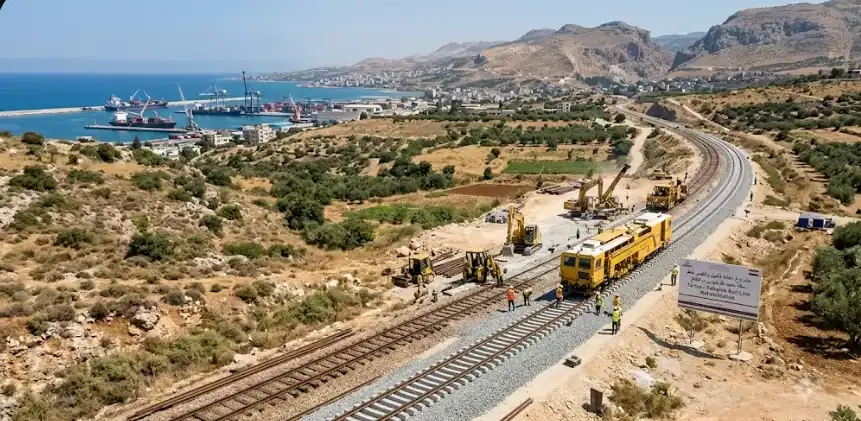
Technical crews from the Tartus branch of the Syrian General Railway Corporation (the public body responsible for Syria's rail network) have commenced rehabilitation works on the rail line connecting Tartus port to Talkalkh station in the western countryside of Homs governorate. The Tartus governorate confirmed in an official statement that the works aim to raise the line's operational efficiency and ensure its full technical readiness, thereby facilitating the smooth flow of rail freight between the port and Syria's interior regions.
According to the Syrian Arab News Agency (SANA), the line runs from Tartus port through the Tartus, Akkar and Samriyah stations to Talkalkh. Engineer Nidal Abd al-Qader, deputy director of the Tartus branch, stated that rehabilitating the line will enhance safety levels and increase its operational capacity, while engineer Mahmoud Ahmad, head of the lines division, described the scope as the replacement of damaged rail sections and the renewal of deteriorated wooden sleepers at station entrances and exits to allow train speeds to be raised safely.
Phased Approach and Timeline
SANA reported that the work was organised in stages, beginning with a field survey to identify weak points along the track, followed by the cataloguing of technical requirements and procurement, and then the replacement of rails and sleepers. Work commenced on 24 April 2026, with a planned duration of three months covering the upper and lower sections of the Tartus to Talkalkh line. No project budget or external contractor was named in the source.
Strategic Importance of the Line
The Tartus to Talkalkh line holds considerable logistical significance, linking one of Syria's principal Mediterranean ports to the western Homs countryside and serving as a key corridor for the movement of goods between the coast and inland Syria. Its rehabilitation is expected to expand the capacity of the national rail network to handle bulk freight, particularly agricultural commodities. The Tartus branch indicated that the corridor is also intended to carry phosphate from the eastern mines toward the port via the Homs to Talkalkh route, alongside wheat, which is currently the primary cargo. The specific line length and capacity figures were not specified in the source.
Grain Transport via Rail
In a related development, the Syrian General Railway Corporation announced on 11 April the commencement of wheat transfer operations from Tartus port to inland storage facilities. The cargo, approximately 40,000 tonnes carried aboard the vessel Inisia, is being transported by rail to the Shanshar silos in Homs and the Nasiriyya silos in Damascus, as part of the government's plan to strengthen food security. At Tartus station, manual switches have been converted to electric operation, making it, according to the source, the first station to operate with an electric switch control system.
Resumption of the Latakia to Aleppo Line
In January, the first grain-dedicated train departed from Latakia port bound for Aleppo, carrying approximately 1,500 tonnes of grain after a suspension of nearly fifteen years. The train travelled along the Latakia to Aleppo corridor, passing through Homs and Hama governorates, marking the return to service of one of Syria's most strategically important rail routes following comprehensive rehabilitation works covering both the track infrastructure and supporting facilities.
National Rail Recovery Framework
These projects form part of a broader national effort to rebuild Syria's rail network, which sustained extensive damage during years of conflict. The Syrian General Railway Corporation is working to restore rail transport as a foundational pillar of the national freight system, with particular emphasis on moving strategic commodities such as grain and foodstuffs between the country's ports and its major inland urban and storage centres.
Frequently Asked Questions
Which rail line is being rehabilitated?
The line connecting Tartus port to Talkalkh station in the western countryside of Homs governorate, running through the Tartus, Akkar and Samriyah stations.
Who is carrying out the works?
The Tartus branch of the Syrian General Railway Corporation.
When did the works begin and how long are they expected to take?
The works commenced on 24 April 2026, with a planned duration of three months for the upper and lower sections of the Tartus to Talkalkh line.
What does the rehabilitation involve?
A field survey to identify weak points, the cataloguing of technical requirements and procurement, and the replacement of damaged rails and deteriorated wooden sleepers at station entrances and exits, in order to raise capacity and allow train speeds to be increased safely.
What goods is the line intended to carry?
Wheat is currently the primary cargo, and the corridor is also intended to carry phosphate from the eastern mines toward the port via the Homs to Talkalkh route.
How does this connect to wider grain transport?
On 11 April, the corporation began moving approximately 40,000 tonnes of wheat from the vessel Inisia at Tartus port by rail to the Shanshar silos in Homs and the Nasiriyya silos in Damascus, as part of a plan to strengthen food security.
Is this part of a larger rail recovery effort?
Yes. It forms part of a broader national effort to restore Syria's rail network, which also included the resumption in January of the Latakia to Aleppo grain line after a suspension of nearly fifteen years.
Update — 2026-05-22
According to the Syrian Arab News Agency (SANA) on 22 May 2026, the Tartus branch of the Syrian General Railway Corporation completed the first phase of maintenance and rehabilitation on the line linking Tartus port to Talkalkh station via Tartus and Akkari stations, and began the second phase. SANA quoted the branch's deputy director, Nidal Abdulqader, as saying the works help raise transport efficiency, increase operating speeds and improve safety levels. No completion date was announced for the second phase.
At network level rather than on this line specifically, Arab News reported on 14 August 2026, citing Syrian railway data, that rail freight rose by nearly 59 percent in the first seven months of 2026 to 663,479 tonnes through July, against 417,859 tonnes in the same period of 2025, and that fuel-oil trains resumed running at 60 km/h while phosphate and grain trains run at 80 km/h following repairs.
Sources
Gallery :

Syria TV: Syrian Railways begins rehabilitation of the Tartus port to Talkalkh line
SANA: Rehabilitation of the phosphate transport line from the Homs countryside mines to Tartus port
Enab Baladi: Start of rehabilitation of the rail line linking Tartus port and Talkalkh
SANA: First grain train departs Latakia port for Aleppo after a fifteen-year suspension