.avif)

Syria Launches Emergency Plan to Rehabilitate Bridges and Develop Key Road Network
.svg)


.avif)
.svg)

Plan Launch and Key Stakeholders
Syria's Ministries of Transport and Finance have jointly announced an emergency plan to rehabilitate bridges and vital road corridors across the country. The announcement followed a ministerial meeting attended by Transport Minister Yarub Badr, Finance Minister Mohammad Yasser Barnieh, and Engineer Muaz Najjar, Director General of the General Establishment for Road Transport. The plan aims to improve the national transport network and accelerate inter-governorate mobility.
Immediate Priorities
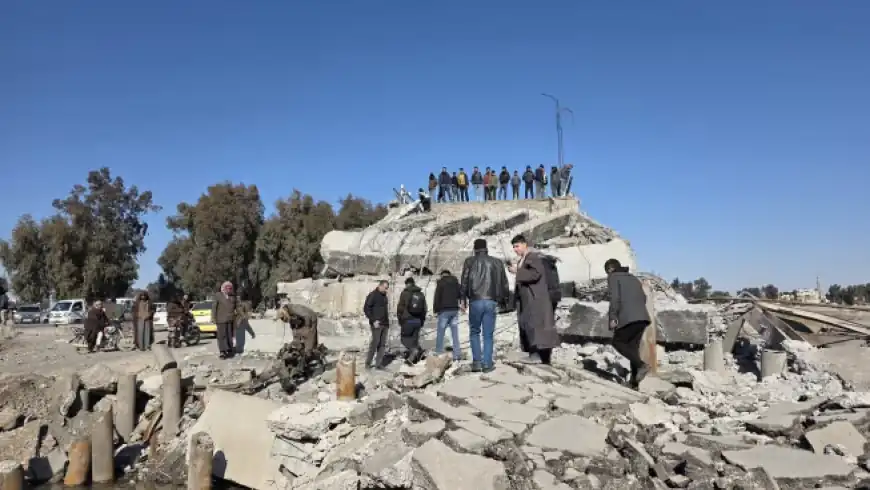
The participants agreed to expedite procedures and secure the necessary funding to begin immediate maintenance works on damaged bridges in Raqqa and Deir ez-Zor governorates, identified as top priorities for the current phase. These areas have sustained severe infrastructure damage, with several Euphrates River crossings destroyed or rendered non-functional during years of conflict.
Financial Framework and Timeline
The plan is aligned with presidential directives and includes the allocation of dedicated credits within the 2026 state budget for priority infrastructure projects. It also encompasses the launch of a three-year programme to develop and expand the main road network connecting the majority of Syrian governorates.
Estimated Costs by Governorate
Reported figures indicate that the rehabilitation programme for Raqqa governorate during 2026 carries an estimated cost of approximately 15 million US dollars, financed through government budget allocations (source: Enab Baladi, syria.tv). For Deir ez-Zor governorate, reporting points to a broader package estimated at around 37 million US dollars, composed of six maintenance projects valued at roughly 6.7 million US dollars (covering the Deir ez-Zor – Al-Mayadin – Bukamal, Deir ez-Zor – Hasakah, and Deir ez-Zor – Raqqa routes) and four strategic bridge rehabilitation projects valued at roughly 30.5 million US dollars (source: Enab Baladi). Combined, the two governorate packages are reported at more than 52 million US dollars (source: Ultra Syria). These amounts are estimates drawn from press reporting of the ministerial discussions and may be revised as detailed studies and tenders are finalised.
External Financing for New Bridges
Beyond budget-funded maintenance, the authorities indicate that discussions are under way with the Saudi Fund for Development to provide a concessional loan for constructing two new bridges, one in Raqqa governorate and one in Deir ez-Zor governorate, with the new-bridge component reported at an estimated 18 million US dollars (source: Enab Baladi). As negotiations are ongoing, the loan terms and final scope are not yet confirmed in the sources.
Targeted Road Corridors
The plan identifies several critical axes for rehabilitation, including:
- The Nassib – Daraa – Damascus – Aleppo highway
- The Damascus – Palmyra – Deir ez-Zor road
- A feasibility study for financing the construction of new bridges over the Euphrates River
Broader Context
This plan forms part of wider government efforts to restore Syria's transport sector, which has suffered severe deterioration following years of conflict and prolonged absence of regular maintenance. The General Establishment for Road Transport serves as the primary executive body responsible for managing the country's central road and bridge network, and its director's participation in the ministerial meeting underscores the operational urgency of the initiative.
Frequently Asked Questions
Which ministries are leading the plan?
The plan is led jointly by Syria's Ministry of Transport and Ministry of Finance, with the General Establishment for Road Transport acting as the primary executive body for the central road and bridge network.
Which areas are the top priority?
Raqqa and Deir ez-Zor governorates are identified as the top priorities for the current phase, given the severe damage to their infrastructure, including several Euphrates River crossings.
How long will the programme run?
Alongside immediate maintenance works, the plan launches a three-year programme to develop and expand the main road network connecting the majority of Syrian governorates.
How is the plan funded?
Maintenance works are financed through dedicated credits within the 2026 state budget. For new bridges, discussions are reported with the Saudi Fund for Development to provide a concessional loan. Reported figures are estimates and may change as studies and tenders are finalised.
What is the estimated cost?
Press reporting puts the Raqqa 2026 programme at approximately 15 million US dollars and the Deir ez-Zor package at around 37 million US dollars, for a combined total reported at more than 52 million US dollars. A new-bridge component is reported at an estimated 18 million US dollars.
Which road corridors are targeted?
Identified corridors include the Nassib – Daraa – Damascus – Aleppo highway and the Damascus – Palmyra – Deir ez-Zor road, alongside a feasibility study for new bridges over the Euphrates River.
Does the platform execute this project?
No. The Rebuilding Syria Platform documents the initiative and connects construction, investment, and expert partners; it does not execute projects directly.
Update — 2026-07-09
According to SANA on 9 July 2026, Moaaz Najjar, director of the General Establishment for Road Transport, reviewed completed and ongoing road and bridge projects for 2026. Among those completed and inaugurated in the first half of the year: rehabilitation of the Grand Rastan Bridge in Homs Governorate at a cost of about USD 3 million. He said the cement plant bridge (the small Rastan bridge) in Homs had been carried out at a cost of about USD 600,000 and "will open shortly."
Under implementation, works in Raqqa Governorate cover rehabilitation of the Al-Rashid and Shreida bridges at a combined cost of roughly USD 1.1 million, plus rehabilitation works on the Maadan bridge; in Deir ez-Zor, the rebuilding of the Al-Siyasiyeh Bridge continues. Works on other corridors include widening of the Idlib–Mastouma road and rehabilitation of the southern Aleppo bypass. The figures above are in US dollars as reported by SANA citing the establishment.
Sources