.avif)
Syria Signs Deal to Develop Oil Shale Deposits
.svg)


.avif)
.svg)

An Untapped Natural Resource
Syria's oil shale deposits are drawing renewed economic attention following the launch of a new investment project linking this resource to the phosphate sector and fertilizer manufacturing. Oil shale is a sedimentary rock containing organic matter that can be converted into oil and gas through thermal processing, with by-products applicable across electricity generation, chemical industries, asphalt materials, and fertilizer production.
Syria's principal oil shale reserves are concentrated in the Khanasir area of rural Aleppo, southeast of the city, where geological estimates indicate substantial quantities with layer thicknesses that could support mining and industrial processing projects under the right conditions.
Scale of the Khanasir Reserve
The scale of the resource was first quantified by Syrian authorities in 2010. According to Sufyan Al-Alao, then Minister of Oil and Mineral Wealth, the estimated quantity of oil shale rock in the Khanasir area is approximately 37 billion tons, announced during a site visit on 27 May 2010. Early survey data cited layer thicknesses reaching up to 240 metres across an initial area of about 150 square kilometres, with oil content measured at 6.9 to 7.9 percent. These are 2010 survey figures and have not been independently re-verified for the current project.
Memorandum of Understanding with a Saudi Firm
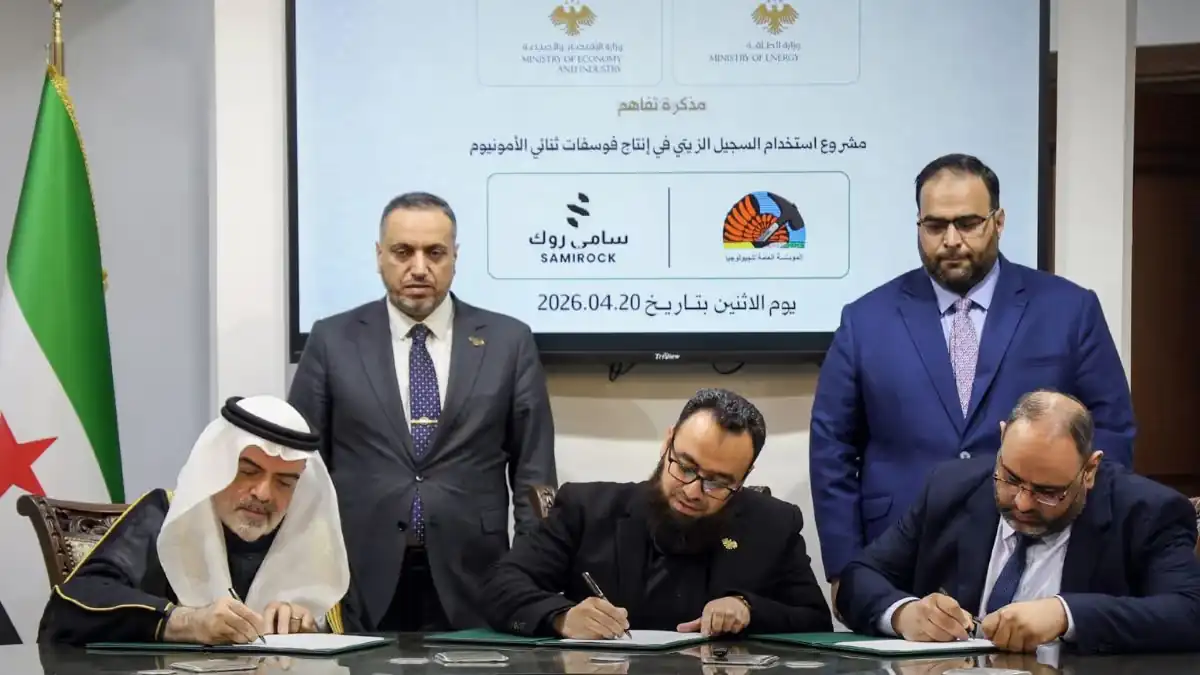
In April 2026, the General Establishment for Geology and Mineral Resources signed a memorandum of understanding with Saudi company SAMIROCK, which specializes in mining, geological surveying, exploration, drilling, and industrial project execution. The signing took place at the Ministry of Energy building in Damascus. The agreement aims to study the use of oil shale as a feedstock in the production of diammonium phosphate (DAP) fertilizer, a phosphate fertilizer widely used in agriculture, leveraging the company's proprietary ammonia gas production technologies within the Khanasir area. The official Syrian news agency (SANA) reports the raw materials for the project as both oil shale and phosphate rock sourced from Khanasir.
Parties and Officials
According to SANA, officials present at the signing included Engineer Ibrahim Al-Addhan, Deputy Minister of Energy for Planning; Basil Abdel-Hanan and Mohammad Yaseen Hawwara, Deputy Ministers of Economy and Industry; Osama Mahmoud, General Manager of the General Phosphate and Mines Company; and Ibrahim Bably, Vice Chairman of SAMIROCK. SAMIROCK's vice chairman Ibrahim Bably stated that the oil shale found in Khanasir ranks among the best in the Arab region in terms of both quality and quantity, noting the strong global demand for phosphate fertilizers.
Project Phases and Financing
Syria's Ministry of Energy outlined a two-phase approach for the project:
- Phase One: Comprehensive evaluation studies covering geological, technical, and logistical aspects over a four-month period, aimed at determining economic feasibility and the parameters of a final contract.
- Implementation Phase: Should feasibility be confirmed, execution is expected to take approximately two years to reach full operational status, according to preliminary estimates.
On financing, the Ministry indicated that bank financing will be the primary mechanism given the scale of investment required and the difficulty of a single entity bearing the full cost directly.
Follow-up Talks and Wider Industrial Potential
The two sides continued discussions after the signing. In a meeting held on 15 June 2026, the parties reviewed the planned geological survey of the site, the identification of laboratory and landfill locations, and the localization of the project in the region. According to SANA, the talks also explored additional industrial opportunities tied to the resource, including the production of rock wool from oil shale, caustic soda and chlorine projects, and marble-based value-added projects. These additional opportunities remain at the discussion stage and are not yet committed projects.
Economic Dimensions of the Project
Political economy researcher Yahya Al-Sayed Omar noted that oil shale's significance extends beyond its role as a partial substitute for conventional fuel, as it serves as a raw material for chemical industries and fertilizer production, conferring broader added value. He added that linking it to DAP production could reduce operational costs, enhance the competitiveness of the final product, and achieve industrial integration among available natural resources.
Al-Sayed Omar identified several key factors bearing on the economic viability of such projects:
- High extraction and processing costs.
- The need for advanced technologies and specialized expertise.
- The long-term nature of investment and slow payback periods.
- The impact of global energy prices on project profitability.
- Availability of adequate infrastructure and a stable investment environment.
Challenges and Historical Context
Oil shale projects face multiple challenges, including technical requirements for modern processing technologies, the financial burden of large-scale investment, and environmental concerns related to water consumption and emissions. Al-Sayed Omar emphasized that the success of partnerships in this sector depends on clear legal frameworks, balanced interests among parties, and a transparent and stable investment climate.
This is not the first time the resource has attracted official interest. Syria's Ministry of Petroleum announced the discovery of oil shale in Khanasir in 2010, and the Syrian Investment Commission presented it in 2021 as a power generation opportunity with an estimated cost of 800 million dollars. A cooperation memorandum was also signed that year with Russia's Ros Geologiya covering an oil shale block, yet none of those initiatives advanced to implementation.
Frequently Asked Questions
What is the oil shale project in Khanasir?
It is an investment project to study using oil shale from the Khanasir area of rural Aleppo as a feedstock for producing diammonium phosphate (DAP) fertilizer, under a memorandum of understanding between Syria's General Establishment for Geology and Mineral Resources and the Saudi company SAMIROCK.
Who are the parties to the agreement?
The memorandum of understanding was signed by Syria's General Establishment for Geology and Mineral Resources and the Saudi firm SAMIROCK, which specializes in mining, geological surveying, exploration, and drilling.
When and where was the memorandum signed?
It was signed in April 2026 at the Ministry of Energy building in Damascus.
Where are Syria's oil shale reserves located, and how large are they?
The main reserves are in the Khanasir area, southeast of Aleppo. A 2010 official estimate put the quantity at approximately 37 billion tons, with layer thicknesses reaching up to 240 metres. This figure is a 2010 survey estimate.
What product will the project make?
The project targets the production of diammonium phosphate (DAP), a phosphate fertilizer with high global demand, using oil shale and phosphate rock from Khanasir together with SAMIROCK's ammonia gas production technologies.
What are the project phases and timeline?
Phase one is a four-month set of geological, technical, and logistical feasibility studies. If feasibility is confirmed, the implementation phase is expected to take about two years to reach full operation, according to preliminary estimates.
How will the project be financed?
According to Syria's Ministry of Energy, bank financing will be the primary mechanism, given the scale of investment required.
Have there been earlier attempts to develop this resource?
Yes. The discovery was announced in 2010, the Syrian Investment Commission offered it as an 800 million dollar power generation opportunity in 2021, and a cooperation memorandum was signed with Russia's Ros Geologiya the same year, but none advanced to implementation.
Update — 2026-06-15
The project has moved from signature to preparation for implementation. According to the Syrian Arab News Agency (SANA) on 15 June 2026, a meeting was held to discuss implementing the memorandum of understanding signed on 20 April 2026 between the General Establishment of Geology and Mineral Resources and Saudi Arabia's SamiRock, under the patronage of the ministries of energy and of economy and industry.
Per the same source, the meeting covered a plan for a comprehensive geological survey of the Khanasir site to obtain precise data on the distribution and characteristics of the oil shale formations ahead of technical and investment studies; the selection of sites for the plant and the landfill and the siting of the project in the area; and mechanisms for securing phosphate from its mines to meet production needs. The meeting also reviewed related industrial opportunities including rock wool production from oil shale, studies for caustic soda and chlorine projects, and marble-based value-added industries. No timeline and no investment figure were announced.
Sources
Enab Baladi: Oil shale, a project to turn a held-back resource into energy
SANA: Syrian-Saudi MoU to invest oil shale in phosphate fertilizer production
SANA: Syrian-Saudi talks to invest Khanasir oil shale for fertilizers and new industrial projects
Syria Oil and Gas News: 37 billion tons estimated oil shale quantity in Khanasir, Aleppo