.avif)

Syria Begins Rehabilitation of Damascus–Aleppo International Highway
.svg)


.avif)
.svg)

Project Scope and Objectives
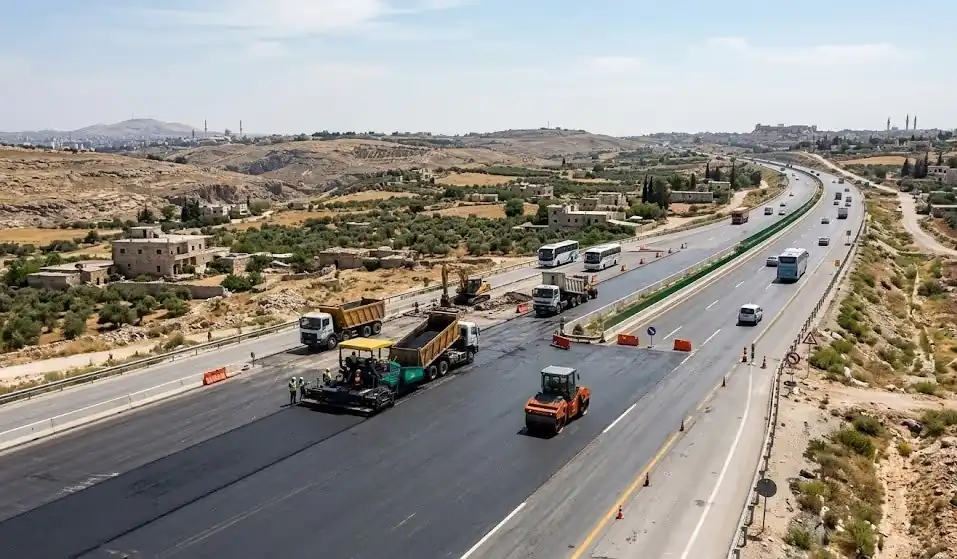
The General Establishment for Road Transport, operating under the Ministry of Transport, has announced the launch of comprehensive maintenance works on the Damascus–Aleppo International Highway. The initiative forms part of a broader national effort to rebuild Syria's primary road network, improve transport connectivity between governorates, and reduce road accident rates. According to the General Establishment for Road Transport, the works began on Thursday, 23 April 2026, and are being carried out in phases (in stages) so that the road is not closed entirely during implementation.
Targeted Sections and Works Underway
The works encompass the rehabilitation of damaged segments along the international highway, with measures in place to maintain uninterrupted traffic flow throughout the implementation period. Technical teams have commenced preparatory operations, alongside the deployment of traffic management procedures designed to ensure smooth vehicle movement during the works. The acting head of the General Establishment for Road Transport, engineer Khader Fattoom, stated that road-marking (paint) operations would begin shortly on the Damascus–Aleppo International Highway within Hama and Homs governorates to improve night-time visibility, and that a study of accident-prone locations (referred to as "black spots") in Hama had been completed in preparation for technical treatment.
The Highway Within the M5 Corridor
The Damascus–Aleppo International Highway forms part of the M5, the motorway that Syrian reference sources describe as the country's most important highway. The M5 runs for approximately 450 kilometres from the Syrian–Jordanian border south of Damascus to the Syrian–Turkish border near Azaz, passing through Daraa, Al-Nabk, Homs, Hama, and Ma'arrat al-Nu'man, and it intersects the M4 near Saraqeb. The corridor therefore links the political capital, Damascus, with the economic centre, Aleppo, forming the backbone of north–south movement in the country (source: Arabic Wikipedia entry on the M5; figure stated by that source).
Technical Assessment Phase
On Saturday, 13 June 2026, the General Establishment for Road Transport launched a comprehensive technical assessment (a structured engineering survey) of the Damascus–Aleppo autostrade to determine maintenance and rehabilitation needs. The assessment runs from the Panorama area in Damascus to the entrance of Aleppo city, with each direction surveyed separately, covering roughly 370 kilometres in total. It is built on three components: measurement of the International Roughness Index (IRI), a laser-based indicator of surface roughness recorded at vehicle speeds of 90 to 100 kilometres per hour; analysis of pavement bearing capacity through periodic measurements at intervals of about 400 metres, expected to take around one week; and high-precision mapping of road defects. The Establishment stated that the assessment is conducted without closing the road or disrupting traffic. The Damascus branch director of the Establishment, Bassam Dakkak, supervised the launch. The participating engineering firms are Lobar (Syrian general contracting; projects manager Abdel-Karim Qaysoun), Al-Jabir Engineering, and Frontier Group International, with Firas Al-Arqsousi acting as assessment supervisor for the participating companies.
Earlier Maintenance Within Idlib Governorate
Prior maintenance on the Aleppo–Damascus international road within the Idlib sector covered approximately 21 kilometres, including asphalt scraping and re-laying at the most damaged locations and the application of thermal road paint in three lanes. That work extended through Khan Sheikhun, Ma'arrat al-Nu'man, Khan al-Sibel, and Saraqeb up to the administrative boundary of Aleppo governorate, and was overseen by Safaa Neama, director of the Road Transport branch in Hama and Idlib.
Strategic Importance of the Highway
The Damascus–Aleppo International Highway ranks among Syria's most vital transport arteries, connecting the capital to the country's largest economic hub and serving high volumes of inter-regional traffic. Its rehabilitation is expected to raise road safety standards and improve the efficiency of movement along this critical corridor, with positive implications for commercial and logistical activity.
Broader Road Rebuilding Context
These works come amid growing attention to road safety in Syria, where major highways have recorded recurring accidents resulting in casualties. The rebuilding of road infrastructure represents a foundational pillar of national recovery efforts, strengthening inter-governorate connectivity and improving the overall quality of logistics services across the country.
Frequently Asked Questions
Who is carrying out the rehabilitation of the Damascus–Aleppo International Highway?
The General Establishment for Road Transport, which operates under the Ministry of Transport, is implementing the works.
When did the works begin?
The comprehensive maintenance works began on Thursday, 23 April 2026, and are being carried out in phases so that the road is not closed entirely.
What does the technical assessment involve?
Launched on 13 June 2026, the assessment runs from the Panorama area in Damascus to the entrance of Aleppo and covers roughly 370 kilometres across both directions. It measures the International Roughness Index (IRI) using laser technology, analyses pavement bearing capacity at intervals of about 400 metres, and maps road defects with high precision, all without closing the road.
Which companies are involved in the technical assessment?
The participating firms are Lobar (Syrian general contracting), Al-Jabir Engineering, and Frontier Group International.
How long is the M5 corridor that the highway belongs to?
According to Arabic reference sources, the M5 runs approximately 450 kilometres from the Syrian–Jordanian border south of Damascus to the Syrian–Turkish border near Azaz, passing through Daraa, Al-Nabk, Homs, Hama, and Ma'arrat al-Nu'man.
What earlier maintenance was completed within Idlib governorate?
Earlier works within the Idlib sector covered approximately 21 kilometres, including asphalt scraping and re-laying at the most damaged locations and thermal road paint in three lanes, extending from Khan Sheikhun through Ma'arrat al-Nu'man, Khan al-Sibel, and Saraqeb to the boundary of Aleppo governorate.
Why is this highway strategically important?
It connects the capital, Damascus, with Aleppo, the country's largest economic hub, and forms the backbone of north–south movement, so its rehabilitation is expected to raise road safety standards and improve the efficiency of commercial and logistical movement.
Update — 2026-07-14
Two documented steps have followed the start of maintenance work. According to the Syrian Arab News Agency (SANA) on 13 June 2026, the General Establishment for Road Transport began a comprehensive technical assessment of the Damascus–Aleppo autostrade, running from the Panorama area in Damascus to the entrance of Aleppo over roughly 370 kilometres in both directions, carried out by Syria's Lobar Engineering together with Qatar's Al-Jabber Engineering and Frontier Group International. The assessment measures pavement smoothness using the International Roughness Index (IRI), scanning from a vehicle travelling at 90 to 100 km/h and recording roughly every 25 millimetres, and measures load-bearing capacity at points about 400 metres apart. It is carried out without closing the road.
On 14 July 2026, SANA reported the launch of seven international tenders covering the rehabilitation of major corridors and the consulting supervision of that work, including Nassib–Damascus, Damascus–Homs, Homs–Aleppo and the Saraqib–Idlib link, all sections of the M5 corridor running between the country's northern and southern borders, alongside a second carriageway on the Damascus–Palmyra road and the upgrade of Palmyra–Deir ez-Zor to dual carriageway. SANA quoted Transport Minister Yarub Badr as saying that tendering internationally aims to secure the highest technical standards and to draw on global expertise in implementation.
Sources
syria.tv – Start of rehabilitation of the Damascus–Aleppo road
SANA – Launch of maintenance works on the Damascus–Aleppo road
SANA – Technical assessment of the Damascus–Aleppo autostrade
SANA – Strategic road projects to link Syrian governorates
SANA – Completion of maintenance on the Aleppo–Damascus road in the Idlib sector