.avif)

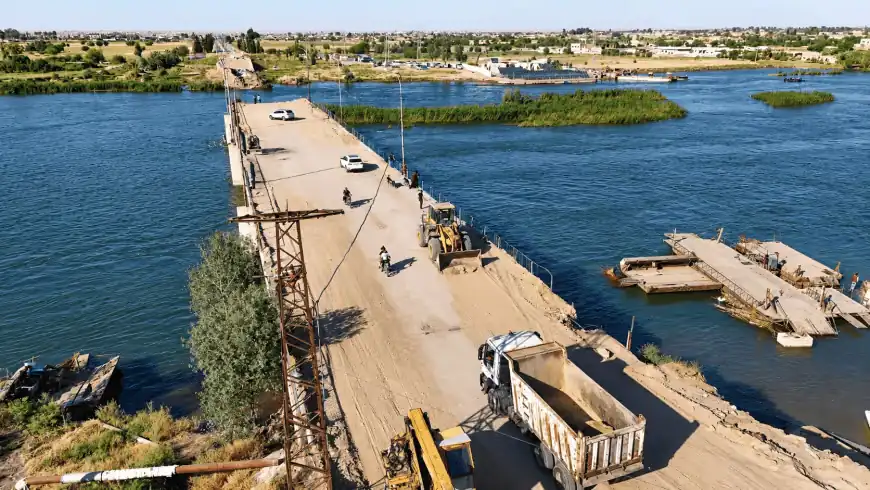
Rebuilding of Al-Siyasiyeh Bridge
.svg)


.avif)
.svg)

Project Scope and Executing Parties
Syria's Ministry of Public Works and Housing has announced the commencement of construction and rehabilitation works on the Al-Siyasiyeh Bridge in Deir ez-Zor Governorate. The project will be executed by the Syrian Construction and Building Corporation, under the supervision of the Ministry of Transport as represented by the General Authority for Road Transport. Works are scheduled to span 12 months.
According to the General Authority for Road Transport, the technical and administrative procedures required to begin works were completed before launch. Engineer Abdel Karim Al-Khader, Director of the Authority's Deir ez-Zor Branch, confirmed that the corporation's teams had finalised these preparatory steps. The launch followed the signing of a maintenance contract between the General Authority for Road Transport and the Syrian Construction and Building Corporation.
Part of a Three-Bridge Rehabilitation Plan
The Al-Siyasiyeh Bridge is one of three Deir ez-Zor crossings included in a coordinated rehabilitation plan, alongside the Al-Mayadeen Bridge and the Al-Ashara Bridge. The plan was announced by Engineer Moaz Najjar, Director General of the General Authority for Road Transport, on 29 May 2026. Engineering studies for the projects have been completed, and the first phase of reinforcement works on the Al-Ashara Bridge was reported as finished ahead of the start of preparation works on the Al-Siyasiyeh and Al-Mayadeen bridges.
Strategic Importance of the Bridge
Al-Siyasiyeh Bridge is classified among the vital and strategic infrastructure assets of Deir ez-Zor Governorate. It serves as a principal corridor linking the city of Deir ez-Zor with its northern countryside and the broader northern regions of the country, functioning as one of the most critical crossing points along the Euphrates River.
Cause of Damage and Residents' Hardship
According to the General Authority for Road Transport, the bridges sustained significant damage from the bombing of the former regime. The destruction of the bridge during years of conflict severed connectivity across wide areas of the governorate, forcing residents to rely on rudimentary river vessels and ferries for daily movement, exposing them to considerable risks, most notably drowning incidents.
Flooding of the Euphrates River further compounded the crisis by destroying the temporary earthen crossings and makeshift bridges, including earlier repairs carried out using basic fill methods, that had been erected to maintain transit. This significantly worsened conditions for commuters on both banks.
Political Context of the Project
The project's launch follows directives issued during a visit by Syrian President Ahmad al-Sharaa to Deir ez-Zor Governorate, during which he reviewed the condition of damaged bridges and ordered the immediate commencement of their rebuilding and rehabilitation.
Development Objectives
The project targets a set of key development outcomes, including:
- Restoring normal daily life and facilitating the movement of citizens
- Boosting economic and service activity across the governorate
- Reducing the risks associated with crossing the Euphrates River
- Reconnecting Deir ez-Zor city with the northern countryside and northern regions
Frequently Asked Questions
Which bridge is being rebuilt and where?
The Al-Siyasiyeh Bridge in Deir ez-Zor Governorate, a principal crossing over the Euphrates River that links Deir ez-Zor city with its northern countryside and the northern regions of the country.
Who is executing the project and who supervises it?
The Syrian Construction and Building Corporation is executing the works, under the supervision of the Ministry of Transport as represented by the General Authority for Road Transport, and within the framework of the Ministry of Public Works and Housing.
How long is the project expected to take?
The works are scheduled to span 12 months.
Is this part of a larger plan?
Yes. The Al-Siyasiyeh Bridge is one of three Deir ez-Zor bridges in a coordinated rehabilitation plan, together with the Al-Mayadeen Bridge and the Al-Ashara Bridge.
Why did the bridge need rebuilding?
According to the General Authority for Road Transport, the bridges sustained significant damage from the bombing of the former regime, and earlier temporary repairs using basic fill methods were destroyed by flooding of the Euphrates River.
What prompted the launch of the project?
The launch followed directives issued by President Ahmad al-Sharaa during a visit to Deir ez-Zor Governorate, where he ordered the immediate rebuilding and rehabilitation of the damaged bridges.
What are the expected benefits?
Restoring normal daily movement, boosting economic and service activity in the governorate, reducing the risks of crossing the Euphrates River, and reconnecting Deir ez-Zor city with its northern countryside and the northern regions.
Update — 2026-07-31
SANA published progress indicators for the Al-Siyasiyeh Bridge rebuilding project in Deir ez-Zor on 31 July 2026. The works, executed by the Syrian Establishment for Building and Construction, stood at 19 per cent actual completion against 8.5 per cent planned, with 16 per cent of the contract period elapsed. The 12-month contract began on 29 May 2026 and runs to 29 March 2027.
Per SANA, reinforced-concrete works on the piers — the project's main activity — had reached 60 per cent with completion expected within 25 days; gantry crane assembly stood at 95 per cent (5 days), steel formwork fabrication at 85 per cent (6 days), and structural steel detailing at 6 per cent. SANA had earlier reported overall completion of 17 per cent on 20 July 2026, with concrete piers being poured within the Euphrates channel and a launching crane installed to speed execution.
Sources