3D Construction Printing as a Strategic Solution for Reconstruction
30.04.2026

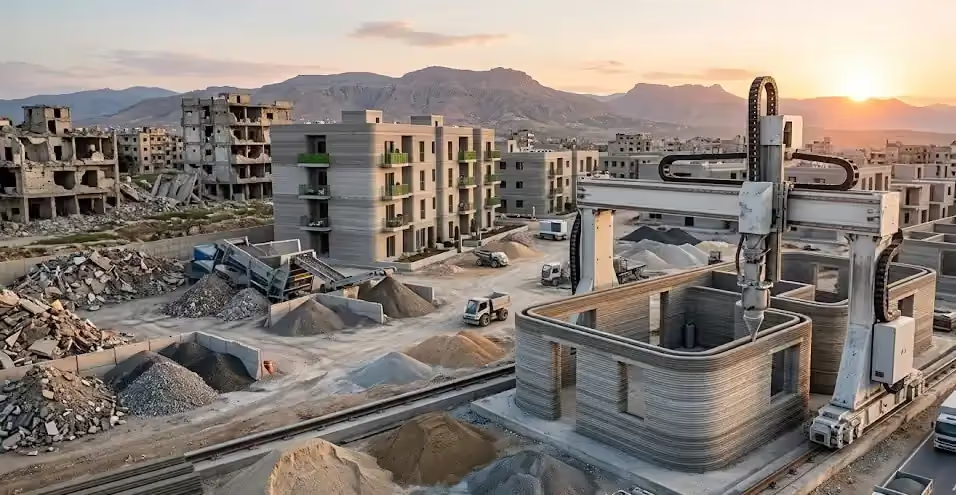
3D Construction Printing (3DCP) represents a fundamental shift in supply chains and real estate execution mechanisms. This technology relies on robotic systems to pump advanced cementitious and concrete materials according to precise digital models, significantly reducing reliance on intensive labor and traditional formwork while delivering unprecedented time and cost efficiency.
I. Performance Indicators and Economic Viability (International Case Studies)
The operational viability of this technology has been proven in several pioneering markets, providing standard benchmarks for reconstruction projects:
- The UAE Experience: Succeeded in reducing construction costs by 50% with the first fully printed office in 2016, targeting 25% of new buildings to be 3D printed by 2030.
- The US Model (ICON): Executed weather and earthquake-resistant homes in under 24 hours, with production costs below $10,000 per unit.
- The Chinese Model (Winsun): Printed 10 housing units in a single day, saving 60% on material costs and 70% on overall execution time.
II. Value Addition in the Context of Reconstruction
Adopting this technology in damaged areas offers strategic advantages beyond traditional construction:
- Addressing the Housing Crisis: Closing the housing gap rapidly, with structural execution times ranging from 24 to 48 hours.
- Resource Management and Sustainability: The ability to recycle rubble and debris into printable building materials, solving a massive logistical and environmental dilemma while lowering raw material costs.
- Reducing Operational Costs: Saving between 30% and 50% compared to traditional methods, enhancing project attractiveness to financing entities.
III. Operational Challenges and Obstacles
Despite its high viability, successful implementation requires addressing core challenges:
- Infrastructure Stability: The absolute reliance of robotics on a stable grid of power and water.
- Initial Capital Expenditure (CAPEX): The need for massive upfront capital to import equipment and transfer technology.
- Skills Gap: An urgent need to train specialized engineering and technical personnel in the digital management of construction operations.
- Regulatory Frameworks: The absence of building codes and legislation regulating the licensing and standards of 3D-printed buildings.
IV. Recommendations and Executive Roadmap
To turn this technology into an operational reality, the following methodology is proposed:
- Pilot Projects: Initiating projects in specific areas (e.g., Rural Damascus or Homs) to evaluate equipment performance under local conditions before scaling.
- International Partnerships for Knowledge Transfer: Contracting with leading global companies (such as ICON or Winsun) to ensure technical supply and training.
- Industrial Localization of Building Materials: Establishing local centers to process building rubble into eco-friendly, pumpable concrete.
- Developing the Legislative Environment: Drafting specific engineering regulations and safety standards to ensure the quality of printed buildings and allow for their official licensing.
30.04.2026
3D Construction Printing, Modern Reconstruction Technologies, Housing Cost Reduction, Rubble Recycling, Future of Contracting in Syria, 3DCP Technology.


.svg)


.avif)