.avif)

railway project linking Saudi Arabia with Syria, Jordan, Turkey, and Europe
.svg)


.avif)
.svg)

Project Overview
Turkish Transport and Infrastructure Minister Abdulkadir Uraloglu has announced that Turkey and Saudi Arabia are targeting the establishment of a regional railway line connecting both countries with Syria and Jordan, with completion expected within the next three to four years. The project aims to strengthen commercial transport links between the Gulf region and Europe through an integrated overland corridor. The minister disclosed these details in interviews with Al Jazeera and Al Arabiya.
The initiative is widely described as a modern revival of the historic Hejaz Railway, the Ottoman-era line that once connected Damascus with the Arabian Peninsula. Turkey, Syria, and Jordan have agreed within a trilateral framework to rebuild and reconnect their railway networks along this route, as part of a wider corridor intended to extend from southern Europe to the Arabian Gulf (source: Petra, the Jordan News Agency).
Scope of Services and Route
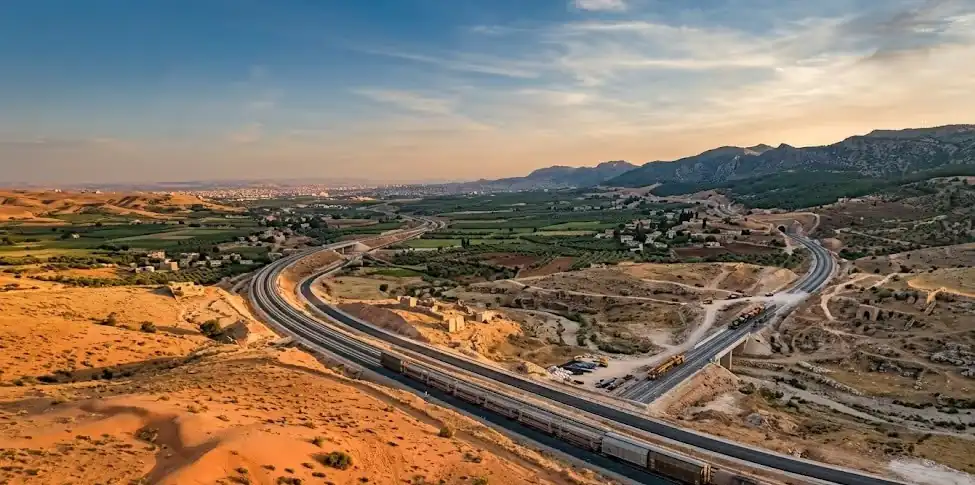
In its first phase, the project will facilitate the transport of goods, oil, natural gas, and passengers between Saudi Arabia, Turkey, Jordan, Syria, and Europe. The proposed route builds on Saudi Arabia's existing rail network, which already extends to the Jordanian border through the Al Haditha crossing, and continues through Jordan and Syria into Turkey and onward to Europe. The minister noted that the line could also serve pilgrims during the Hajj season, and that it would help reduce the impact of navigation disruptions in the Strait of Hormuz on regional trade flows.
Uraloglu confirmed that rail connectivity works between Islahiye, Kilis, and Gaziantep in southeastern Turkey have already been completed, while a gap of approximately 400 kilometers between Syria and Jordan remains to be bridged before the full corridor is operational.
Participating and Prospective Countries
The project's first phase includes Saudi Arabia, Turkey, Jordan, and Syria. The minister indicated that other states may join in subsequent phases, including:
- United Arab Emirates
- Kuwait
- Qatar
- Sultanate of Oman
According to coverage by Railway PRO, Yemen and Iraq were also cited as possible participants in later phases.
Investment and Financing
The minister revealed that the project will operate under a dedicated financing plan, with investments of approximately $100 million allocated to rehabilitating the railway line between Turkey and the city of Aleppo, paving the way for a direct link extending further to Damascus.
On the Saudi side, the Minister of Transport and Logistics Services, Saleh al-Jasser, stated that the feasibility study for the railway link with Turkey via Jordan and Syria is expected to be completed by the end of 2026. As reported by Petra, the Jordan News Agency, this study is intended to underpin the project's broader regional integration and trade objectives.
Diplomatic Framework
The announcement follows the signing in Riyadh of two memoranda of understanding between Turkey and Saudi Arabia covering logistics and railway cooperation, as part of broader efforts to enhance bilateral trade and transport connectivity. The corridor has been characterized in regional and international media as a land trade route that may complement or compete with alternative routes seeking to link the Gulf with Europe.
Frequently Asked Questions
Which countries are part of the regional railway in its first phase?
The first phase connects Saudi Arabia, Turkey, Jordan, and Syria, with the route extending onward to Europe.
What is the expected timeline for completion?
Turkish Transport and Infrastructure Minister Abdulkadir Uraloglu stated that completion is expected within the next three to four years.
What section of the corridor still needs to be built?
A gap of approximately 400 kilometers between Syria and Jordan remains to be bridged. The works between Islahiye, Kilis, and Gaziantep in southeastern Turkey have already been completed.
How much investment is allocated to the Syrian segment?
Approximately $100 million is allocated to rehabilitating the railway line between Turkey and the city of Aleppo, paving the way for a direct link to Damascus.
What will the railway transport?
In its first phase, the line will move goods, oil, natural gas, and passengers, and it may also serve pilgrims during the Hajj season.
What is the status of the feasibility study?
Saudi Minister of Transport and Logistics Services Saleh al-Jasser said the feasibility study for the link via Jordan and Syria is expected to be completed by the end of 2026.
Which additional countries could join in later phases?
The United Arab Emirates, Kuwait, Qatar, and the Sultanate of Oman were named, and Railway PRO also cited Yemen and Iraq as possible later participants.
How does the project relate to the Hejaz Railway?
It is described as a modern revival of the historic Ottoman-era Hejaz Railway, with Turkey, Syria, and Jordan agreeing within a trilateral framework to rebuild and reconnect their networks along this route.
Update — 2026-08-07
According to Al Jazeera Net on 7 August 2026, Syrian Transport Minister Yaarub Badr met the World Bank's Middle East director, Dalia Khalifa, to discuss support for rehabilitating and developing Syria's railway network. Al Jazeera reported the allocation of "about USD 200 million through a World Bank grant to finance railway infrastructure development projects." The report put Syria's network at roughly 2,800 km — 2,500 km standard gauge and 300 km narrow gauge — of which only around 1,000 km remains serviceable, while damage to the railways is estimated at some USD 5.5 billion. The meeting also covered a CMA CGM proposal to study container movement by rail from the Latakia port container terminal to dry ports in Aleppo, Homs and Damascus.
On the regional corridor specifically, the same report stated that the concept under discussion rests on linking Türkiye and Europe through Syria, on to Jordan and then Saudi Arabia and the Gulf states. Anadolu Agency reported on 9 June 2026 that the Turkish and Saudi transport ministers signed memoranda of understanding on transport and railways covering logistics centres, technology, infrastructure, training and human resources.
Sources
Railway PRO, Turkey and Saudi Arabia plan a railway to Europe via Jordan and Syria
Daily Sabah, Turkey and Saudi Arabia aim to build rail link with Jordan and Syria
Petra (Jordan News Agency), Saudi minister on railway study via Jordan and Syria
The Times of Israel, Turkish-Saudi rail to link Jordan and Syria