.avif)
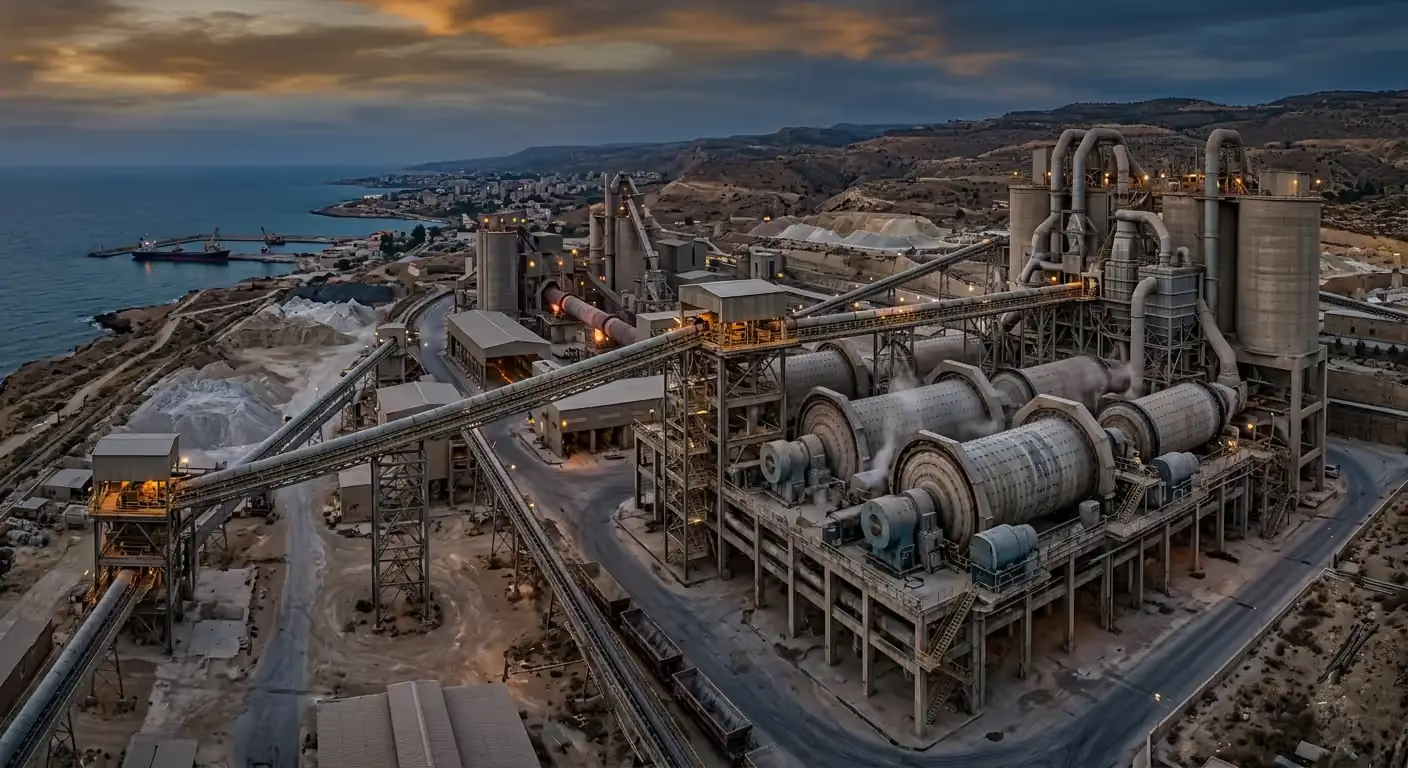
Tartus Cement Plant Grinding Mills


.svg)


.avif)
.svg)

Overview
The UAE company QZ is rehabilitating and operating the grinding mills of the Tartus cement plant under a 15-year investment contract signed on 22 March 2026 with the state General Company for the Manufacture and Marketing of Cement and Building Materials (Omran). According to SANA, the contract covers producing cement at the plant from imported clinker ground to the Syrian standard specification.
Earlier reports
Technical Reference reported on 7 October 2025 that the investment in the Tartus mills had been finally awarded to a UAE group. The site described it as the first grinding-only cement project in Syria, linked the reliance on imported clinker to the worn condition of the plant, the environmental challenges of producing clinker and the shortage of raw materials, and noted the plant's location near the port and the railway line. In December 2025, Omran's director general, Eng. Mahmoud Fadila, told SANA that the Tartus plant had been taken up for investment by a UAE company, and on 12 March 2026 he said that work on rehabilitating and developing the Tartus mills by a UAE group was progressing.
The contract model
At the signing, Fadila told SANA that the contract restarts the grinding stage of the production chain without a heavy financing burden on the state, brings in modern expertise and technology through a partnership with the private sector, and keeps the facility in state ownership.
Employment, as projected
Fadila put the expected employment at about 300 direct jobs and more than 2,000 indirect ones. These are projections stated at signing, not verified outcomes.
Status
The project is in trial operation and gradual rehabilitation. Trial production began on 20 April 2026 with one mill running, while studies for upgrading the mills and kilns are being prepared (see the update below).
Terms not stated in the sources
The sources do not state the investment value, the revenue-sharing terms or the clinker supply arrangements.
Update, 20 April 2026: trial production begins
Trial production began at the Tartus cement plant on 20 April 2026, after preparatory works were completed in several sections of the plant, SANA and Al-Ikhbariah reported. QZ project manager Eng. Ahmad Salma said one mill is running in the trial phase, while engineering and design studies to develop and modernise the plant's mills and kilns are being prepared in contact with specialised foreign companies. According to Al-Ikhbariah, he put the current mill's output with local equipment at about 100 tonnes per hour, against a design capacity of 120 tonnes per hour, producing grade 32.5 cement, with trials under way to produce grade 42.5.
Salma said about 500 of the plant's existing workers are employed, with the aim of reaching at least 1,000 to run the plant after its development. Eng. Bassam Ali, director of Omran's coastal branch, told SANA that experts have been brought in and training courses prepared for the workers, that the investment contract takes international environmental standards into account at a plant that had previously been a source of pollution for the surrounding area, and that plant output is expected to exceed one million tonnes of cement a year after the preparatory period. The output and workforce targets are announced projections, not verified outcomes.
Gallery :
Technical Reference (Arabic), the UAE invests in the Tartus cement plant mills, 7 October 2025
SANA (Arabic), a new investment map for the cement sector, 4 December 2025
SANA (Arabic), trial production begins at the Tartus cement plant, 20 April 2026
Al-Ikhbariah (Arabic), trial operation launched at the Tartus cement plant, 21 April 2026